How Often Should You Walk Your Dog?

Most dogs benefit from at least one or two walks each day, but there is no universal duration that fits every dog. A healthy adult may be comfortable with a 20–30-minute daily walk, while a puppy, senior dog, flat-faced breed, or dog returning to exercise may need shorter, more frequent outings.

Quick answer: Start with one or two daily walks that your dog can finish comfortably. Use 10–15 minutes as a gentle starting point when needed, increase gradually, and shorten the walk when heat, cold, pavement, health, or fatigue changes what your dog can safely handle.

The practical version.

A practical starting point

The right routine is the one your dog can repeat without pain, distress, or prolonged exhaustion.

QuestionPractical answer
How many walks per day?One or two is a useful baseline for many dogs. Puppies may need more frequent short outings, while some adult dogs need additional exercise and enrichment.
How long should each walk be?Many healthy adult dogs can tolerate about 20–30 minutes, but that is a starting point—not a requirement. Build from the duration your dog handles comfortably.
What if my dog is out of shape?Start with 10–15 minutes, or less if needed. Add time gradually instead of attempting one long walk.
Do puppies need long walks?No. Puppies usually do better with short, frequent, low-impact activity at their own pace. Avoid rigid minute formulas and repetitive, high-impact exercise.
What about senior dogs?Keep them moving when they are willing and able, but slow the pace and favor shorter, more frequent walks. Ask your veterinarian about arthritis, heart, breathing, or mobility limits.

Watch the dog, not only the clock.

What determines the right amount

Age, health, conditioning, breed, weather, and the individual dog matter more than a universal minute chart.

Age and life stage

Puppies have less endurance and developing bodies, so several short walks or play sessions are generally safer than one prolonged outing. The commonly repeated five-minutes-per-month rule is not supported by scientific evidence and may be too much for some puppies and too little for others. Favor varied, low-impact movement at the puppy's pace and ask your veterinarian when public walks are appropriate based on vaccination status.

Healthy adult dogs can usually build duration gradually. Senior dogs still benefit from movement and outdoor enrichment, but they may need a slower pace, predictable footing, and more frequent rests.
Read the veterinary review of the puppy exercise rule →

Health, fitness, and body condition

A sedentary or overweight dog may struggle with a duration that an active dog handles easily. The American Veterinary Medical Association recommends beginning with short, frequent walks and gradually building toward one or more 15-minute periods of brisk walking.

Dogs with arthritis, heart disease, breathing problems, recent injuries, or other medical conditions need an individualized plan from a veterinarian.

Read the AVMA dog-walking guidance →

Breed and the individual dog

Breed can suggest energy level, body shape, and heat tolerance, but it does not determine the exact routine. Herding and working dogs may need more physical and mental activity; lower-energy dogs may be satisfied with less.

Flat-faced dogs can overheat more easily and may need shorter walks, cooler hours, and more frequent rests. Individual preference and conditioning still matter within every breed.

Read the veterinarian-reviewed PetMD guidance →

Weather, pavement, and route

The same dog may comfortably walk for 30 minutes on a cool, dry morning and struggle after 10 minutes in heat, humidity, strong sun, ice, or deep cold. Hot pavement can burn paws even when the air feels manageable.

Wind, visibility, hills, unfamiliar terrain, and poor footing also change the useful duration. Adjust the schedule and route before treating the daily target as fixed.

See the PDSA exercise and weather guidance →

Start below the limit.

Build a routine your dog can repeat

The goal is not to tire your dog out at any cost. It is to find a useful amount, recover well, and adjust gradually.

1.

Start with a comfortable duration

For a dog returning to regular exercise, 10–15 minutes is a reasonable starting point; some dogs need less. Finish before the dog is exhausted.

2.

Watch during and after

Notice pace, breathing, gait, willingness to continue, and recovery. Also watch for soreness, limping, or unusual fatigue later that day.

3.

Add one variable at a time

Increase duration, pace, hills, or frequency gradually—not all at once. Add a small amount only when the current routine feels comfortable.

4.

Keep the routine flexible

Use shorter walks plus sniffing, training, food puzzles, or indoor play when weather or health limits outdoor exercise. Mental stimulation complements walking.

Frequency and duration by life stage

These are useful starting patterns, not prescriptions. Your veterinarian and your dog's response should override a generic chart.

What mattersUseful starting patternWhat to watch
PuppySeveral short, low-impact outings and play sessions at the puppy's pace.Vaccination guidance, fatigue, hot pavement, cold, repetitive jumping, or hard running.
Healthy adultOne or two daily walks; many tolerate 20–30 minutes and can build gradually.Breed tendencies, conditioning, behavior, weather, pavement, and recovery.
High-energy adultMultiple activity or enrichment sessions may be useful across the day.Do not rely on distance alone; include sniffing, training, play, or breed-appropriate activity.
Senior dogShorter, slower, and often more frequent walks.Limping, stiffness, difficulty with curbs, heavy panting, or delayed recovery.
Out of shapeBegin with 10–15 minutes or the comfortable limit below that.Heavy panting, repeated rests, slowing on the return trip, or soreness afterward.
Flat-faced dogShorter walks during cooler windows with frequent rests.Heat, humidity, noisy or difficult breathing, weakness, or excessive panting.

When to shorten, delay, or stop the walk

A daily target is never more important than pain, breathing, weather, or safe footing.

  • Stop when your dog is limping, stumbling, lying down, reluctant to continue, or struggling to breathe.
  • Turn back for unusually heavy panting, excessive drooling, abnormal-looking gums, weakness, or reduced responsiveness.
  • Shorten or reschedule when pavement is uncomfortable to touch, or heat and humidity remain high during the planned walk.
  • Use another route or indoor activity when ice, darkness, storms, smoke, poor air quality, or unsafe footing make the walk risky.
  • Follow your veterinarian's vaccination guidance before taking a puppy into public spaces used by unfamiliar dogs.
  • Ask your veterinarian how a health condition, medication, injury, or recent surgery should change the exercise plan.

Common questions.

Dog-walking frequency and duration, answered

Is one walk a day enough for a dog?

It can be enough outdoor walking for some lower-energy dogs when the walk is appropriate and the dog also gets potty breaks, play, training, and mental enrichment. Many dogs benefit from two walks or additional activity. Use the dog's health, behavior, fitness, and recovery—not a universal quota—to judge the routine.

Is a 20-minute walk enough for a dog?

A 20-minute walk can be a useful daily session for many dogs and may be plenty for a puppy, senior dog, flat-faced breed, or dog building fitness. Active adult dogs may need more total activity or enrichment. Quality, pace, terrain, sniffing, weather, and the individual dog all change what 20 minutes means.

How long should I walk my puppy?

Keep puppy walks short, varied, and low impact, and let the puppy set the pace. Avoid using the five-minutes-per-month formula as a medical rule; it is not supported by strong scientific evidence. Ask your veterinarian about vaccination timing, joint health, breed-related risks, and suitable activity.

How long should I walk a senior dog?

Use a duration the dog can finish without pain or prolonged fatigue. Slow, frequent movement can help some senior or arthritic dogs stay mobile, but the plan should reflect the dog's health. Shorten the route if the dog limps, stops, lies down, pants heavily, or struggles with curbs.

Should I walk my dog at the same time every day?

A consistent routine can help a dog know what to expect, but safety comes first. Move the walk to a cooler, warmer, calmer, or brighter window when weather and pavement make the usual time uncomfortable.

Can Walk Window help choose when to walk my dog?

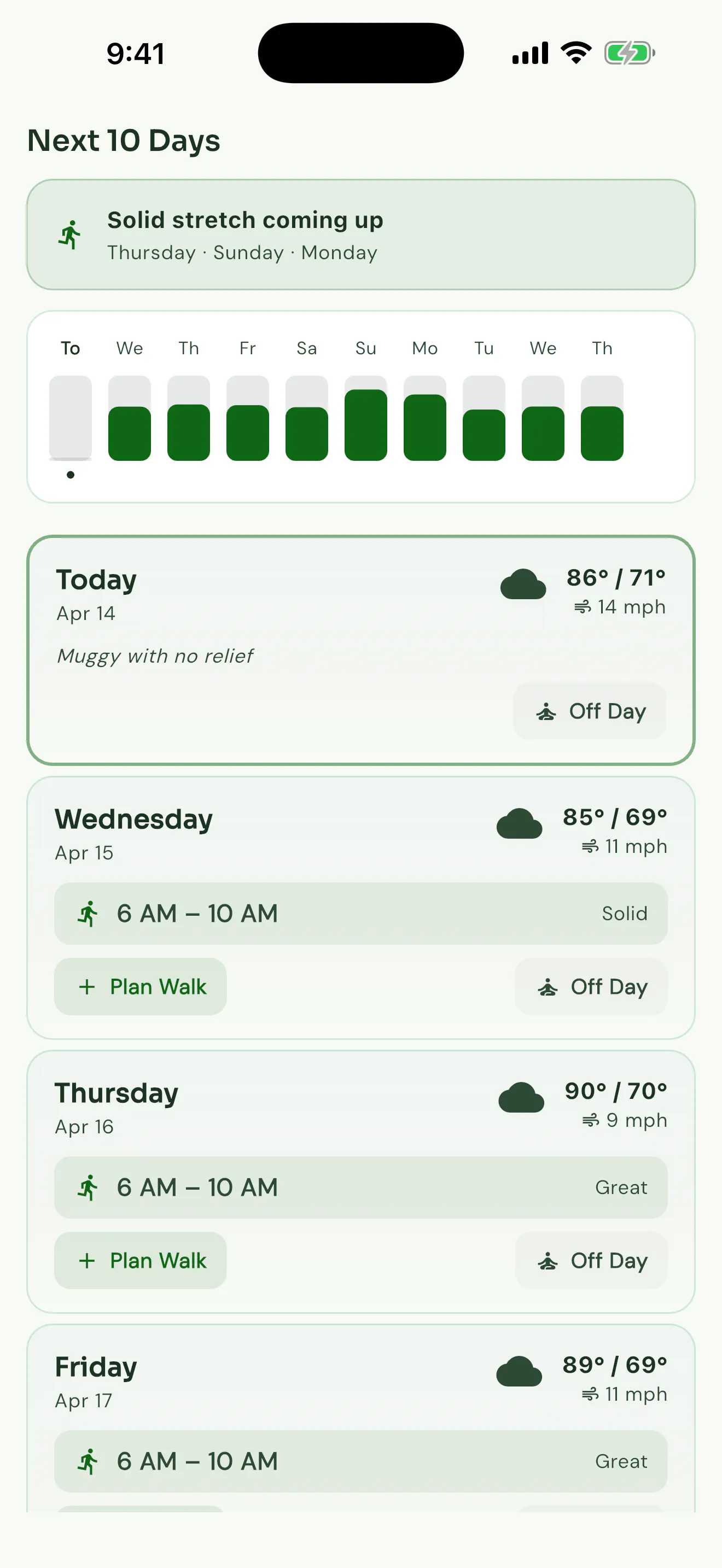
Walk Window compares local conditions across the day and surfaces the most comfortable walking window. Dog Walker mode adds pavement-temperature guidance and tighter thresholds for dogs that are more vulnerable to heat, helping you place the right-length walk in a safer part of the day.

Walk Window 10-day walking forecast with the best hour shown for each day

One last thing.

Get today’s walking window.

Walk Window does the forecast-checking. You just step outside.

Two walks a day, rain or shine? We’ll find the driest windows.