How Weather Affects Your Walk: Temperature, Wind, and Humidity Explained
Weather is more than a single number. When you glance at the temperature before heading out, you're looking at one piece of a much bigger picture. Temperature, wind, humidity, precipitation, UV, and air quality all play a part — and they affect different walkers in different ways.
Understanding how each weather factor lands on your body during a walk helps you make better choices about when to step outside. It also explains why two days with the same temperature can feel completely different.
Temperature: The Baseline
Temperature is the starting point for walk comfort. It sets the range, and everything else nudges it up or down.
How Your Body Manages Heat While Walking
Walking is gentle work, but it is still work. Even on an easy walk, your body produces 2-3 times the heat it makes at rest. Walk more briskly, or carry weight, and that climbs to 4-6 times. Your body sheds that heat in three ways:
- Blood vessels widen — blood flows toward the skin to release heat
- Sweating — moisture on the skin evaporates and cools you
- Breathing — you exhale warm, moist air
These cooling tools work well in moderate conditions. They struggle when it's too hot (heat can't escape fast enough), too humid (sweat can't evaporate), or too cold (blood vessels close down and hands and feet lose circulation).
Why 45-75°F Is the Sweet Spot
In this range, your body keeps up with the heat of walking without strain. You don't overheat, you don't need heavy layers, and your heart and lungs work easily. That's why most people instinctively call this range "perfect" for walking.
How Different Walkers Feel Temperature
Not every walker generates the same heat:
- A comfortable walk around the block: ideal range 45-75°F. The standard.
- A walk with the dog (lots of starts and stops): similar ideal range, but with pavement temperature as an extra thing to watch.
- A brisker walk, or a walk carrying weight: the ideal range shifts down to about 40-78°F. More body heat means it's comfortable a little cooler, and uncomfortable a little sooner when it warms up.
Walk Window quietly takes the kind of walker you are into account when it picks today's best stretch. A 78°F afternoon might be a great window for an easy walk and only a fair window for someone walking briskly with weight.
Wind: The Invisible Modifier
Wind is the most underrated weather factor for walkers. It can make a 55°F day feel like 40°F, or turn a pleasant 70°F afternoon into a tiring battle against gusts.
How Wind Affects Walking
Cooling effect: moving air pulls heat off your body faster than still air. In cold weather, that's wind chill — uncomfortable and, in the extreme, unsafe. In hot weather, a light breeze actually helps by speeding up sweat evaporation.
Physical resistance: walking into a headwind takes more effort. A 15 mph headwind is roughly like walking up a gentle hill. A tailwind, on the other hand, gives you a small push.
Noise and comfort: steady wind above 15 mph creates constant noise and buffeting that wears on you even if the temperature is fine. It isn't dangerous, but it takes the pleasure out of the walk.
Dust and pollen: strong wind kicks up dust, pollen, and grit that bother eyes and lungs.
When Wind Starts to Matter
Most walkers start noticing wind around 8 mph, and find anything above 20 mph too much for comfort. If you walk more briskly or carry weight, the numbers shift a little higher — closer to 12 mph before it bothers you and 25 mph as the upper limit. Two reasons: extra weight steadies you against gusts, and the cooling effect is welcome when you're working harder.
The Gust Factor
Forecasts report sustained wind speed, but gusts are what you actually feel. Gusts can run 50-100% higher than the sustained number. "15 mph wind with gusts to 25" means you'll feel 25 mph pulses throughout the walk. Plan for the gusts, not the average.
Humidity: The Silent Saboteur
Humidity doesn't get the attention it deserves. It's less obvious than temperature or wind, but it has an outsized effect on comfort, especially in warm weather.
How Humidity Affects Your Body
Sweating is your main cooling tool during a walk. Sweat works by evaporating off your skin, which takes heat with it and cools you down. Humidity decides how well that works.
- Low humidity (below 40%): sweat evaporates quickly. Cooling is efficient. You feel dry.
- Moderate humidity (40-60%): sweat evaporates at a reasonable rate. Comfortable for most.
- High humidity (above 60%): sweat evaporates slowly. It pools on your skin. You feel sticky and warm even if the temperature isn't extreme.
- Very high humidity (above 80%): sweat barely evaporates. Cooling is severely limited. The risk of heat illness goes up sharply.
The Dew Point: A Better Number
Relative humidity is what most forecasts show, but dew point is a more reliable comfort signal because it doesn't shift around with the temperature during the day.
| Dew Point | Comfort Level | |-----------|--------------| | Below 50°F | Dry, very comfortable | | 50-60°F | Comfortable | | 60-65°F | Starting to feel sticky | | 65-70°F | Uncomfortable — heavy, oppressive air | | Above 70°F | Miserable — keep outdoor time short |
Once you learn to read dew points, humidity stops surprising you. A 75°F day with a 55°F dew point is delightful. A 75°F day with a 68°F dew point is sticky and unpleasant.
When Humidity Starts to Matter
Most walkers start to feel humidity around 55%. If you walk briskly or carry weight, that bumps up to closer to 60% — you already expect to sweat — but humid air still drags on comfort once it climbs.
Precipitation: The Binary Factor
For most walkers, rain is close to a yes-or-no decision: walk or don't walk.
Light Rain
A drizzle is manageable with a rain jacket. Some walkers actually enjoy a light-rain walk — fewer people are out, the air smells clean, and the temperature is often mild. Walk Window treats light precipitation (below 30% chance) as a small comfort hit, not a reason to skip.
Moderate to Heavy Rain
Most walkers will skip a walk in steady rain, and that's reasonable. Beyond the discomfort, wet surfaces are slippery and visibility drops.
Thunderstorms
Lightning makes outdoor walking dangerous, full stop. If you can hear thunder, head inside. Walk Window steers you well clear of any hour with thunderstorms in the forecast.
Snow
Light snow is beautiful for walking if you have good footwear and the ground isn't icy. Heavy snow makes walking slow and tiring. Ice is the real danger — more on that in the winter walking guide.
After the Rain
The stretch right after rain is often excellent: cooler air, lower pollen, washed pavement, a little extra humidity to soften the temperature. Post-storm walks are an underrated sweet spot.
UV Index: The Long-Term Factor
UV doesn't change how your walk feels in the moment, but it adds up over time. For daily walkers out for 30-60 minutes in the sun, UV matters.
| UV Index | Risk Level | Action | |----------|-----------|--------| | 0-2 | Low | No precautions needed | | 3-5 | Moderate | Sunscreen for walks over 30 minutes | | 6-7 | High | Sunscreen, hat, sunglasses | | 8-10 | Very High | Seek shade during peak hours, full sun protection | | 11+ | Extreme | Avoid midday outdoor time |
UV peaks between 10 AM and 4 PM and is strongest in summer months. Walking before 10 AM or after 4 PM cuts UV exposure sharply.
Air Quality: The Hidden Variable
Air quality doesn't register with most walkers until it's bad. But when you're walking outdoors, you're breathing in more of whatever is in the air than someone sitting inside.
Common air quality concerns for walkers:
- Wildfire smoke: more and more common in summer and fall. Fine particles (PM2.5) reach deep into the lungs.
- Ozone: builds on hot, sunny, low-wind days. Peaks in the afternoon. Irritates airways.
- Pollen: seasonal — worst in spring and fall. Peaks in early morning and late afternoon.
- Traffic exhaust: highest near busy roads during rush hour.
AQI thresholds for walkers:
- 0-50 (Good): no concerns
- 51-100 (Moderate): sensitive walkers should keep outdoor time shorter
- 101-150 (Unhealthy for Sensitive Groups): most walkers should ease back
- 151+ (Unhealthy): stay inside or keep it very short
How Walk Window Reads the Day
Walk Window doesn't treat every weather factor the same way, and it doesn't read the day the same way for every walker. Here's the general order of things:
Temperature is the lead. It sets the range. A day that's well outside your comfort range can't be fully rescued by good wind and humidity.
Wind and humidity are strong shapers. Either one can turn a fine temperature into an uncomfortable hour, or make a borderline temperature feel pleasant.
Precipitation is a hard mark against an hour. Even a moderate chance of rain pulls a window down because most walkers will bail.
UV and air quality are quieter factors that matter when they're bad but don't earn an hour bonus points when they're good — they're more about whether to add a hat or shorten the walk than about picking the best window.
The kind of walker you are nudges all of this. If you walk briskly or carry weight, wind matters a little less and the comfortable temperature range opens up a little wider. If you're walking the dog, hot pavement gets its own warning.
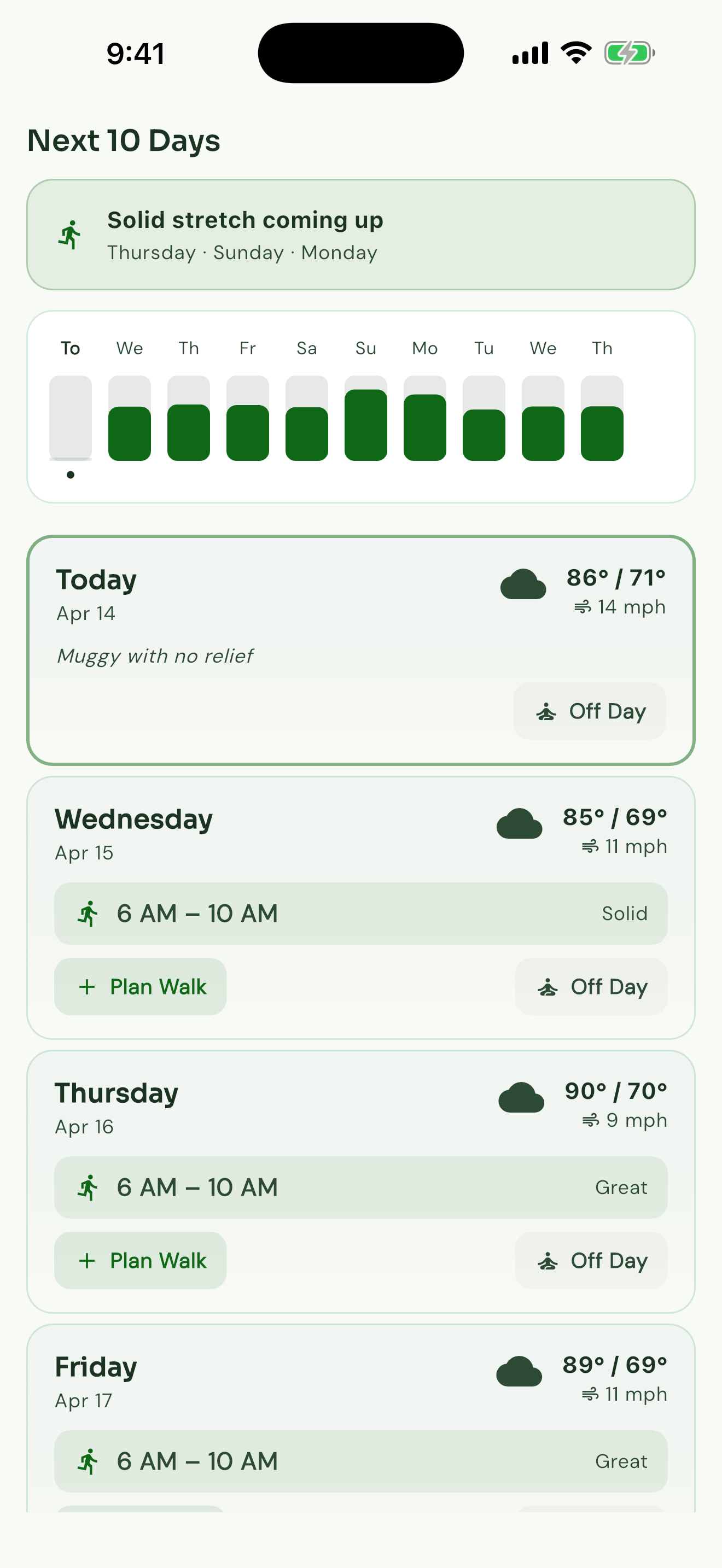
That's what separates Walk Window from a plain weather app. A weather app gives you the raw numbers. Walk Window tells you what those numbers mean for your walk, and shows you the best window — whether that's Go Walk Now, a Good Window later, or Skip Today.
Frequently Asked Questions
Which weather factor matters most?
Temperature, by a wide margin. It sets what's possible. The most important second factor depends on the season: humidity in summer, wind in winter.
Can perfect wind and humidity make up for bad temperature?
Partly. A light breeze can make 80°F feel like 75°F. Low humidity can make 85°F manageable. But no amount of wind makes 95°F a comfortable walk, and no amount of dry air makes 10°F feel warm.
Why does the same temperature feel different on different days?
Because temperature is only one piece. 70°F with 40% humidity, a 5 mph breeze, and sunshine feels perfect. 70°F with 80% humidity, 20 mph wind, and gray skies feels clammy and raw. Same thermometer reading, completely different walk.
How does elevation affect walking weather?
Higher elevation usually means cooler temperatures (about 3.5°F per 1,000 feet), drier air, stronger UV, and more wind. If you walk at elevation, your comfortable temperature range may sit a little differently than the sea-level numbers above.