Is It Too Hot to Walk My Dog? A Pavement Temperature Guide
If the air temperature is 77°F on a sunny day, the asphalt under your dog's paws can reach 125°F or higher. That's hot enough to cause burns in under 60 seconds. Pavement temperature is the single most overlooked danger in dog walking, and it's the reason "it doesn't feel that hot to me" is never a safe way to judge conditions for your dog.
How Hot Does Pavement Actually Get?
Asphalt absorbs and retains solar radiation far more efficiently than air. On a sunny day, the surface temperature of dark pavement can be 40-60°F hotter than the ambient air temperature.
Here's what that looks like in practice:
| Air Temperature | Approximate Asphalt Temperature | Risk Level | |----------------|-------------------------------|------------| | 77°F | 125°F | Caution | | 86°F | 135°F | Danger | | 87°F | 143°F | Extreme Danger | | 95°F+ | 150°F+ | Do Not Walk |
These numbers assume direct sun exposure during peak hours (roughly 11 AM - 4 PM). Shaded pavement, grass, and lighter-colored surfaces will be significantly cooler.
Key fact: Skin destruction in dogs can occur at pavement temperatures as low as 120°F with prolonged contact. At 150°F, burns can happen in under 60 seconds.
The 7-Second Rule
The simplest test for pavement safety:
- Place the back of your hand flat on the pavement
- Hold it there for 7 seconds
- If it's too hot for your hand, it's too hot for your dog's paws
This test works because the skin on the back of your hand is roughly similar in heat sensitivity to a dog's paw pads. If you can't comfortably hold your hand there for a full 7 seconds, don't walk your dog on that surface.
Important caveat: The 7-second rule is a quick field test, not a precise measurement. It's possible for pavement to feel borderline to you but still cause damage to a dog's paws over the course of a 20-30 minute walk.
Safe Pavement Temperature Thresholds
Below 120°F — Safe
Paw pads can handle these temperatures for normal walk durations. Most morning and evening walks fall into this range, even in summer.
120°F - 140°F — Caution
Short walks on pavement are possible, but keep them brief. Stick to shaded routes and grassy areas when available. Watch your dog for signs of discomfort: lifting paws, reluctance to walk, or trying to move to grass.
140°F+ — Danger
Do not walk your dog on pavement. At these temperatures, paw pad burns can happen quickly. If you must go outside, stay exclusively on grass and shaded surfaces.
Brachycephalic Breeds: Lower Thresholds
Brachycephalic breeds — pugs, bulldogs, French bulldogs, Boston terriers, boxers, and similar flat-faced dogs — have a harder time regulating body temperature through panting. For these breeds, lower the caution threshold to 105°F pavement temperature and avoid walks entirely when pavement exceeds 130°F.
Factors That Affect Pavement Temperature
Surface Type
Not all ground is equal:
- Dark asphalt: Hottest. Absorbs the most solar radiation.
- Concrete/light sidewalk: 10-20°F cooler than dark asphalt
- Brick: Similar to concrete, varies by color
- Grass: Dramatically cooler — often close to air temperature
- Dirt/packed earth: Cooler than pavement, warmer than grass
- Sand: Can get extremely hot — sometimes hotter than asphalt
Sun Exposure and Time of Day
Pavement temperature tracks solar radiation, not just air temperature. This means:
- Early morning (before 9 AM): Pavement has cooled overnight. Often safe even if the day will be hot.
- Late morning to early afternoon (10 AM - 2 PM): Pavement heating rapidly. Temperatures peak around 2-3 PM.
- Peak heat (2 PM - 5 PM): Maximum pavement temperatures. Avoid if possible.
- Evening (after 6 PM): Pavement starts cooling, but retains heat. Dark asphalt can stay hot for hours after sunset.
Key insight: Pavement cools slower than air. Even after sunset, asphalt that baked all day can remain dangerously hot for 2-3 hours.
Cloud Cover
Overcast skies dramatically reduce pavement heating. A cloudy 85°F day might have pavement temperatures 20-30°F lower than a sunny 85°F day. This is why air temperature alone is an unreliable indicator.
Previous Days
Consecutive hot days compound the problem. After several 90°F+ days, pavement retains more baseline heat and starts each morning warmer than it would after a cool spell.
Signs of Paw Pad Burns
Even careful owners can miss dangerous conditions. Know the signs:
- Limping or reluctance to walk
- Licking or chewing at paws
- Paw pads appear darker than usual, or are red/blistered
- Visible damage — pads look rough, peeling, or have missing layers
- Dog sits down and refuses to move during a walk
If you suspect paw pad burns:
- Move your dog to a cool surface immediately (grass, shade, indoors)
- Rinse paws with cool (not cold) water
- Do not apply ice directly
- Contact your veterinarian — burns can worsen over 24-48 hours
Best Times to Walk Your Dog in Hot Weather
For most summer days (air temperatures 80°F+), safe walking windows are:
- Early morning: Before 8 AM is almost always safe. Before 7 AM is ideal.
- Late evening: After 7 PM, with the caveat that pavement may still be warm. After 8 PM is typically safe.
- After rain: Rain cools pavement dramatically and quickly. A post-rain walk can be safe even during afternoon hours.
On extreme heat days (95°F+), you may need to limit outdoor time to grass-only walks or very early morning outings.
Breed-Specific Considerations
Small Dogs
Small dogs walk closer to the ground, where radiant heat from pavement is stronger. A Chihuahua's body absorbs more reflected heat than a Great Dane's. Keep walks shorter and watch for heat stress.
Brachycephalic Breeds
As mentioned above, flat-faced breeds overheat faster because their shortened airways are less efficient at cooling through panting. Use the lower pavement thresholds (105°F caution) and monitor closely.
Double-Coated Breeds
Huskies, Samoyeds, Malamutes, and similar breeds have insulating coats that work both ways — keeping them warm in winter and trapping heat in summer. They're more prone to overheating during hot-weather walks. Never shave a double coat (it doesn't help and can cause sunburn), but do limit hot-weather walk duration.
Senior Dogs and Puppies
Older dogs and puppies are less efficient at temperature regulation. Their paw pads may also be thinner or more sensitive. Use conservative thresholds.
How Walk Window Helps With Pavement Heat
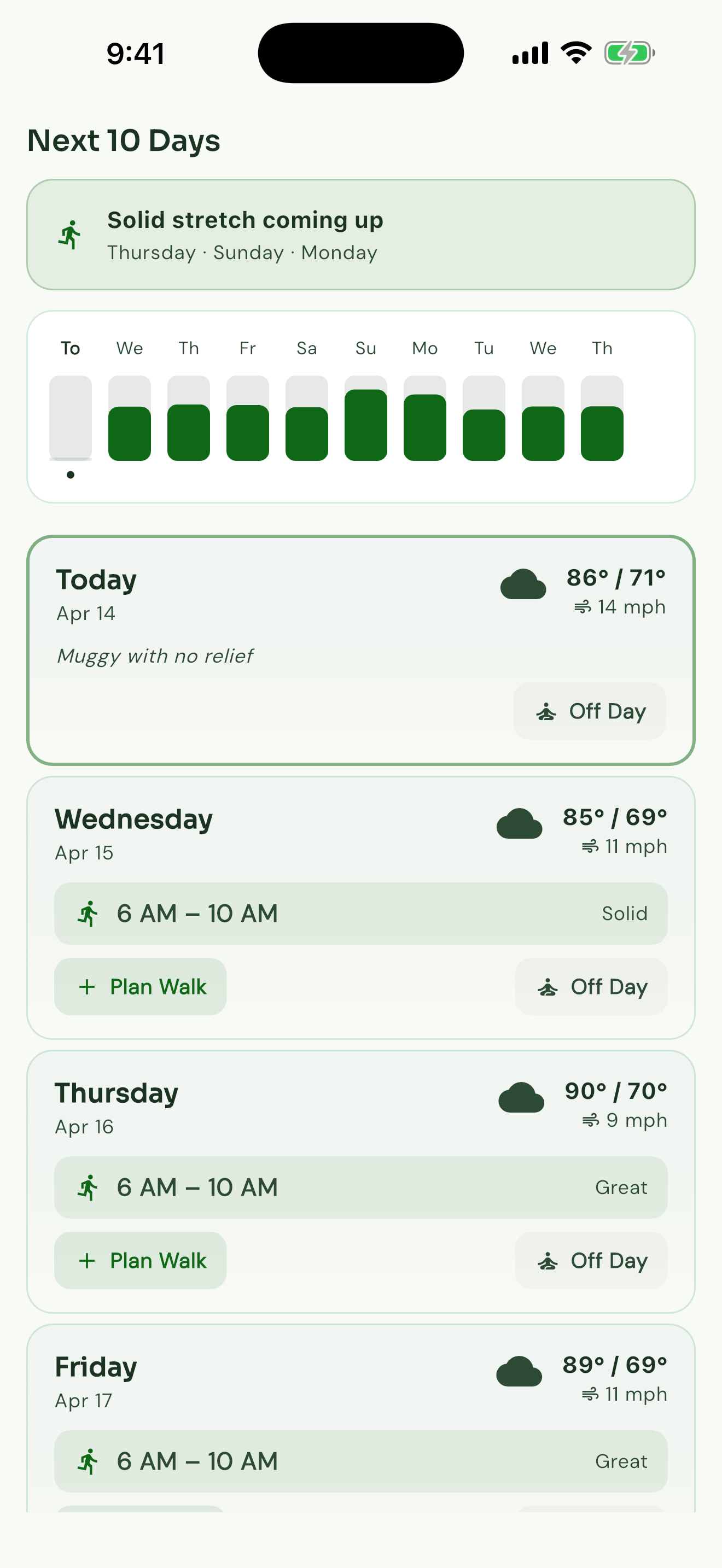
If you walk a dog, Walk Window shows you when the pavement is safe — hour by hour, for the whole day. Here's what you'll see:
- An estimated pavement temperature for every hour, so you don't have to guess from the air temp
- Green, yellow, and red badges on the hourly timeline — safe, caution, danger
- Thresholds that match your dog — pick Small, Medium, Large, or Brachycephalic when you set things up
- A heads-up notification when pavement is heading into the caution or danger range around your usual walking times
- A walk window that accounts for the ground, not just the air
You don't need to do the 7-second test or guess from the thermometer. Open the app, look at the badges, and you'll know whether it's safe to head out.
Frequently Asked Questions
At what air temperature should I start worrying about pavement?
Start paying attention when air temperatures exceed 75°F on sunny days. At 77°F air temp with direct sun, asphalt can already reach 125°F. On overcast days, you have more margin.
Are dog booties effective?
Yes, dog booties provide a barrier between paws and hot pavement. However, many dogs resist wearing them, and poorly fitting booties can cause other problems (blisters, restricted movement). They're a good option if your dog tolerates them, but adjusting your walk timing is more reliable.
Does walking on grass completely eliminate the risk?
Grass is dramatically cooler than pavement — usually within a few degrees of air temperature. Walking exclusively on grass eliminates pavement burn risk. However, your dog can still overheat from exertion in hot weather even on grass, so heat stroke risk remains.
How long does it take for pavement to cool after sunset?
Dark asphalt typically takes 2-3 hours after sunset to cool to safe temperatures on a hot day. After a 95°F day, pavement at 8 PM might still be 120°F+. Wait until at least an hour after sunset, and test with the 7-second rule before heading out.
Protecting your dog's paws isn't complicated — it just requires awareness that air temperature and ground temperature are very different things. Check before you walk, choose your timing wisely, and when in doubt, stay on the grass.