Best Time to Walk in Summer: Beat the Heat
Summer is the hardest season for walkers. Heat, humidity, UV exposure, and scorching pavement all conspire to shrink your comfortable walking window to a fraction of the day. But that window still exists — you just need to find it.
For an older walker who walks for health — the kind of walk a doctor recommends — heat is a real safety issue, not a minor inconvenience. Getting the timing right is what keeps the daily walk doable through July and August.
The best time to walk in summer is early morning (6-8 AM) or evening (7-9 PM). These windows avoid peak heat, reduce UV exposure, and give pavement time to cool (morning) or not yet reach maximum temperature (early morning). The rest of the day? Proceed with caution.
Why Summer Walking Is Tricky
Heat Index vs. Actual Temperature
The number on the thermometer is only part of the story. Heat index — the combination of air temperature and humidity — is what your body actually experiences.
| Air Temp | Humidity | Heat Index | Walking Risk | |----------|----------|------------|-------------| | 85°F | 40% | 84°F | Comfortable for most | | 85°F | 70% | 93°F | Caution — fatigue sets in faster | | 90°F | 50% | 95°F | Caution — limit walk duration | | 90°F | 70% | 106°F | Dangerous — avoid extended walks | | 95°F | 50% | 104°F | Dangerous | | 95°F | 70% | 124°F | Extreme danger — stay inside |
Humidity above 60% significantly impairs your body's ability to cool itself through sweat evaporation. A "dry" 95°F day in Phoenix is more walkable than a "humid" 85°F day in Houston — even though the thermometer says otherwise.
UV Radiation
Summer UV peaks between 10 AM and 4 PM. Extended walking during these hours increases sunburn risk and long-term skin damage. UV intensity is highest at solar noon (roughly 1 PM in most time zones during daylight saving time).
If you must walk during peak UV hours:
- Wear sunscreen (SPF 30+, applied 15 minutes before)
- Light-colored, loose-fitting clothing
- A hat with a brim
- Sunglasses
Pavement Temperature
Summer pavement is dangerous for both dogs and barefoot walkers. On a 95°F day, asphalt in direct sun can exceed 150°F — hot enough to cook an egg, and hot enough to burn skin or paw pads in seconds.
Read our complete pavement temperature guide for specific thresholds and the 7-second rule.
The Two Summer Walk Windows
Summer walking divides your day into two distinct opportunities:
The Morning Window (6-8 AM)
The morning window is the gold standard for summer walking:
- Temperature: Overnight cooling brings temps to their daily low. Even in a heat wave, 6 AM might be 75°F when the afternoon will hit 100°F.
- Humidity: Often higher in the morning due to dew point, but the cooler temperature compensates.
- Pavement: Cool from overnight. Safe for dogs.
- UV: Low. The sun is at a low angle.
- Crowds: Fewer people, quieter routes.
The downside? You have to get up early. In summer, that's the trade. Set the alarm.
One thing to keep in mind: the window narrows as summer progresses. In June, you might have until 9 AM. By August, 8 AM is already getting hot in many regions.
The Evening Window (7-9 PM)
The evening window is more accessible for most schedules but has tradeoffs:
- Temperature: Still warm but declining. Usually 5-15°F cooler than the afternoon peak.
- Humidity: Can actually increase as temperatures drop (relative humidity rises).
- Pavement: Still hot. Asphalt retains heat for 2-3 hours after peak heating. Test before walking your dog.
- UV: Low to none as the sun sets.
- Daylight: Ample through late June, shrinking through August.
The evening window works well for most walkers but can be risky for dog walkers if pavement hasn't cooled enough. Wait until closer to sunset, and stick to grassy routes if possible.
Summer Walking Safety
Hydration
Dehydration sneaks up on walkers because you don't feel thirsty until you're already behind on fluids.
- Pre-hydrate: Drink 16 oz of water in the hour before your walk
- During: 4-8 oz every 15-20 minutes for walks over 30 minutes
- After: Replace fluids lost during the walk — if your urine is dark yellow, drink more
- Electrolytes: For walks over 45 minutes in high heat, plain water isn't enough. Add electrolytes or drink a sports drink.
Heat Exhaustion Warning Signs
Know the progression from heat discomfort to heat emergency:
- Heavy sweating — your body is working hard to cool down (normal)
- Fatigue and weakness — slow down or stop
- Headache, dizziness, nausea — stop walking, find shade, drink water
- Confusion, rapid heartbeat, cessation of sweating — medical emergency. Call 911.
If you feel dizzy or nauseous during a summer walk, stop immediately. Find shade, drink water, and cool your neck and wrists with water. Don't try to "push through it."
Brisk and Weighted Walking Considerations
If you walk briskly or carry weight, summer demands extra caution:
- Your body generates more heat the harder you're working
- A 75°F morning that feels fine for a slow walk can feel like 85°F when you're moving briskly or carrying a weighted pack
- In high heat, take it easier — a shorter walk, a slower walk, or less weight is the right call. The walk you used to take in cool weather isn't the walk to take today.
- Walk Window adjusts your window for the kind of walker you are, so brisk and weighted walkers see comfortable hours that reflect the extra heat they generate
Summer Walking by Month
June
The transition month. Early June still has spring-like mornings in many regions. By late June, summer heat is fully established.
- Best windows: 6-9 AM, 7-9 PM
- Dog walkers: Morning walks are safest for paws
- Watch for: First heat waves often catch people off guard
July
Peak summer. The hottest month in most of the US. Walk windows are at their narrowest.
- Best windows: 6-7:30 AM, after 8 PM
- Dog walkers: Before 7 AM or after sunset only on hot days
- Watch for: Consecutive heat days where pavement never fully cools
August
Still extremely hot, but daylight starts shortening. Evening windows shrink as sunset creeps earlier.
- Best windows: 6-8 AM is your most reliable option
- Dog walkers: Same as July — early morning is safest
- Watch for: Late-season heat waves, tropical humidity in coastal areas
Tips for Surviving Summer Walks
- Commit to mornings — The morning window is the most reliable and most comfortable. Make it a habit.
- Take it easier — The long, comfortable walk you take in spring or fall isn't the walk for a July afternoon. A slower walk, a shorter loop, or both is the right call when it's hot.
- Choose shaded routes — A tree-lined neighborhood street can be 10°F cooler than an exposed path.
- Wear light colors — Dark clothing absorbs more heat. White or light-colored, loose-fitting clothing reflects it.
- Carry water — Always. Even for "short" walks.
- Watch for storms — Summer thunderstorms can develop quickly, especially in the afternoon. Check radar before heading out.
How Walk Window Helps in Summer
Summer is when Walk Window earns its keep. When your comfortable walking hours shrink from 12+ in spring to 3-4 in summer, finding the right window matters.
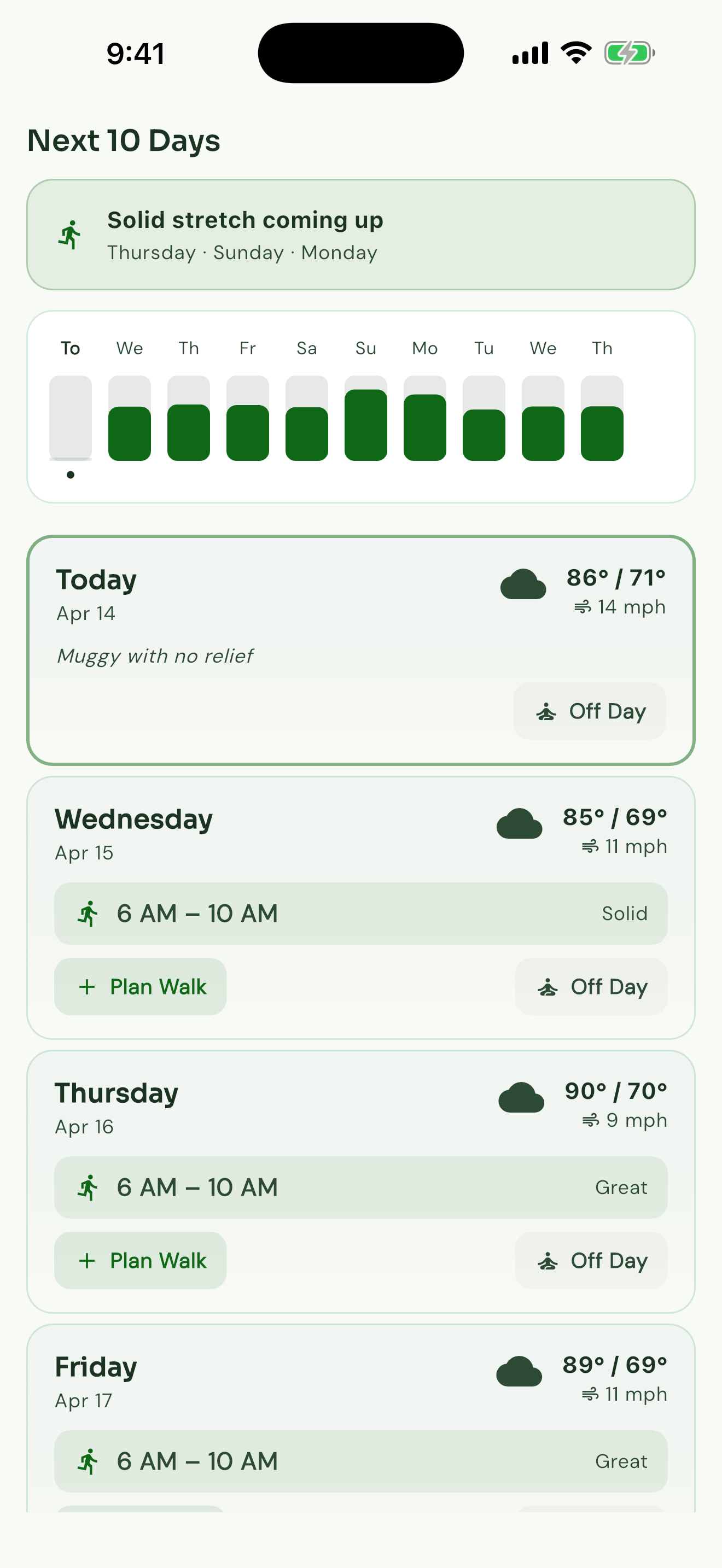
Walk Window watches the day's forecast — heat, humidity, the way they add up — and shows you today's best stretch. You see when your window opens, and when it closes. For dog walkers, pavement temperature badges on the hourly timeline make the decision instant — green means go, red means wait.
The "earlier window" reminder is especially valuable in summer. If tomorrow morning is looking better than usual, you'll know the night before so you can set the alarm.
Summer walking isn't about avoiding the outdoors — it's about getting the timing right. Find your window, hydrate, and go.