Best Time to Walk in Spring: Your Seasonal Walking Guide
Spring is the season of unpredictability. One week it's 72°F and sunny, the next you're dodging thunderstorms in a 50°F windchill. But spring also delivers some of the best walking conditions of the year — if you know when to go.
The best time to walk in spring is typically mid-morning (9-11 AM) or late afternoon (3-5 PM), when temperatures have warmed from overnight lows but haven't peaked, and before evening storms roll in. But the real answer depends on what spring throws at you on any given day.
What Makes Spring Walking Different
Temperature Swings
Spring temperatures are volatile. A 30-degree swing within a single day isn't unusual in many parts of the country. Morning lows in the 40s can climb to afternoon highs in the 70s — both of which are comfortable for walking, but require different clothing.
The ideal walking temperature range for most people falls between 45-75°F, and spring regularly delivers this range. The challenge is timing your walk to catch the sweet spot rather than the extremes.
Rain and Storms
Spring brings increased precipitation in most regions. Afternoon thunderstorms become common, especially in the South and Midwest. The pattern is often predictable:
- Mornings: Usually drier, with storms building later
- Early afternoon: Humidity rises, clouds build
- Late afternoon/evening: Highest storm probability
This means morning walks are generally the safest bet for avoiding rain in spring. But don't write off post-storm walks — the air after a spring thunderstorm is often crisp, clean, and perfectly comfortable.
Allergies
For the roughly 25% of adults with seasonal allergies, spring walking requires strategic timing:
- Pollen counts peak in the early morning (5-10 AM) when plants release pollen, and again in the late afternoon when it settles
- Best allergy window: Mid-morning to early afternoon, or immediately after rain (rain washes pollen from the air)
- Worst allergy conditions: Warm, dry, windy days — pollen goes everywhere
- Best allergy conditions: After a soaking rain, overcast days with low wind
If allergies are a major factor for you, tracking pollen counts alongside weather data helps you find windows where both conditions and air quality work.
Wind
Spring is often windier than summer or fall, especially in plains states and coastal areas. Sustained winds of 15-20 mph are common and can make an otherwise pleasant walk feel uncomfortable.
Wind affects walkers differently:
- Headwind: Increases effort, feels colder than actual temperature
- Tailwind: Barely noticeable, can mask heat buildup
- Crosswind: Annoying and destabilizing, especially on exposed routes
For most walkers, wind becomes uncomfortable above 8-10 mph sustained and unpleasant above 15 mph. Check wind forecasts, not just temperature, before heading out.
Spring Walking by Month
March: Transition Month
March is the most unpredictable spring month. Snow is still possible in northern states while southern regions are already hitting the 70s.
- Best time to walk: Midday, when temperatures peak and morning frost has cleared
- Watch for: Lingering ice on shaded paths, muddy trails, sudden cold snaps
- Clothing strategy: Layers you can shed — it might be 45°F when you leave and 60°F when you return
April: Prime Walking Season Begins
April is when spring walking truly opens up in most of the country. Consistent 50-70°F days become common, trees leaf out, and daylight extends past 7 PM.
- Best time to walk: Morning (8-10 AM) or late afternoon (4-6 PM)
- Watch for: Afternoon storms, pollen surges, occasional cold rain
- Clothing strategy: Light layers, a packable rain jacket
May: Near-Perfect Conditions
May is arguably the best walking month of the year in many regions. Temperatures are warm but not hot, humidity hasn't built to summer levels, and daylight stretches to 8 PM or later.
- Best time to walk: Almost anytime — May offers the widest walk windows
- Watch for: First heat waves, increasing humidity in southern regions, late-spring storms
- Clothing strategy: T-shirt and shorts territory for most walks
Tips for Better Spring Walks
Check the Radar, Not Just the Forecast
Spring weather changes fast. A "30% chance of rain" might mean scattered storms that miss you entirely, or it might mean a line of storms heading your direction in an hour. A quick radar check before walking gives you a real-time picture that hourly forecasts can't match.
How to Layer
Three layers for spring walking:
- Base: Moisture-wicking shirt (not cotton — cotton stays wet)
- Mid: Light fleece or quarter-zip for morning walks
- Outer: Packable wind/rain shell
You'll shed layers as you warm up and as the day heats. Tie the mid-layer around your waist or pick routes that loop back home so you can drop layers.
Adjust Your Route for Conditions
- Windy day? Choose routes with tree cover or buildings for wind breaks
- Allergy day? Avoid parks with heavy tree pollen — urban routes may be better
- Rainy morning? Wait for the rain to pass, then enjoy the post-storm air quality
- Sunny and warm? Take advantage — these are your prime walk windows
Protect Your Dog's Paws (Already)
People forget that pavement heating starts in spring. A sunny 75°F day in May can push asphalt above 120°F. If you walk a dog, start paying attention to pavement temperatures earlier than you think.
How Walk Window Helps in Spring
Spring's variability is exactly why a weather-aware walking app is most useful. When conditions change hourly, guessing the right time to walk is a coin flip.
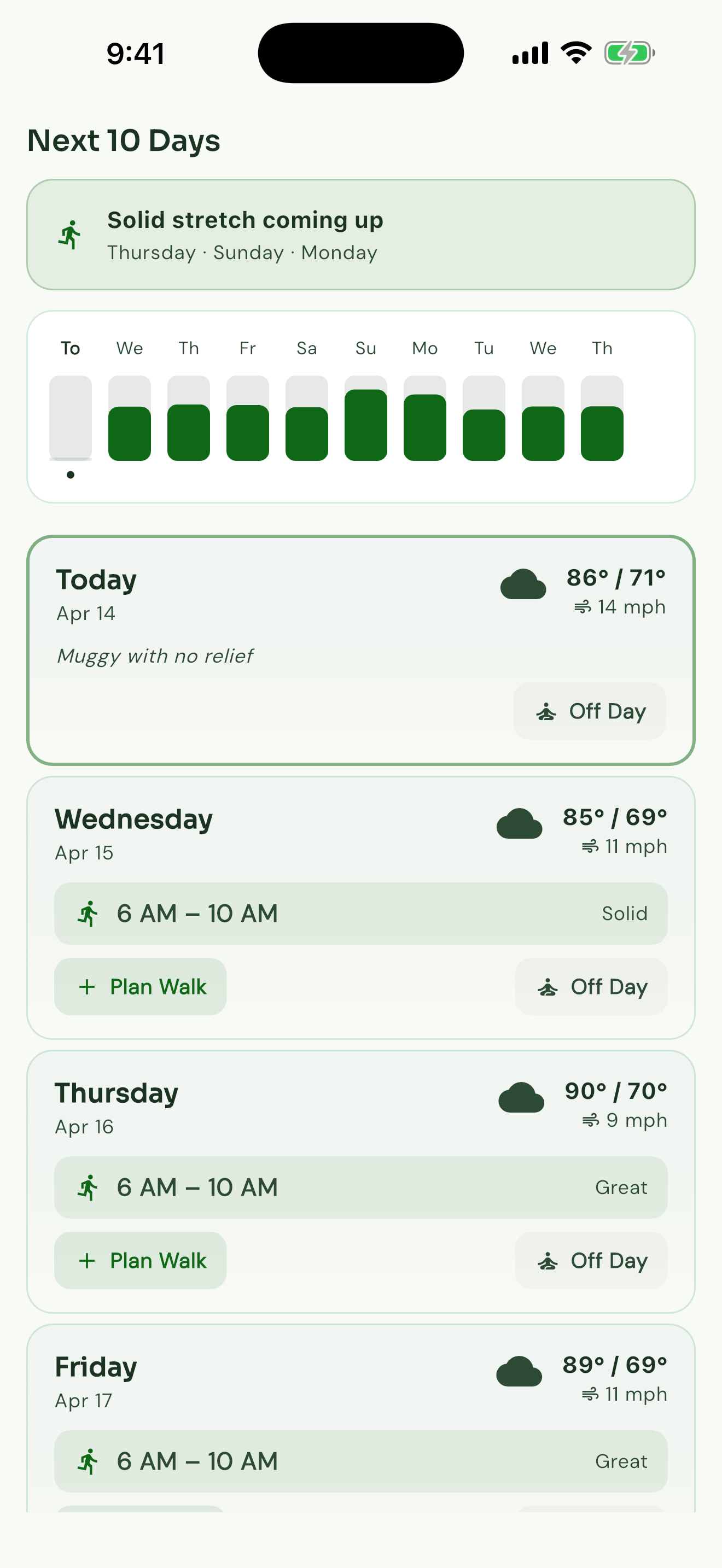
Walk Window reads each hour of the day against your preferences and shows you the best window. On a spring day with morning fog, midday warmth, and afternoon storms, it might point you to a 10 AM - 12 PM window you wouldn't have spotted by glancing at a weather app.
The app also sends a quiet nudge when conditions are unusually good — a "standout day" alert when spring delivers one of those rare days that line up across the board. Don't miss those.
Spring Walking: The Quick Version
- Best months: April and May for most of the US
- Best time of day: Mid-morning (9-11 AM) or late afternoon (3-5 PM)
- Biggest challenges: Rain, allergies, temperature swings, wind
- Pro tip: Mornings are more reliable than afternoons for avoiding storms
- Don't forget: Pavement heating starts earlier than you'd expect — watch out for dogs
Spring rewards the flexible walker. The conditions are often perfect — you just need to catch the right hours.