Walking Weather: What Temperature Is Too Cold or Too Hot to Walk?
For most walkers, the ideal temperature range is 45-75°F. Below 20°F becomes dangerous without proper gear. Above 90°F poses serious heat risks. But these numbers only tell part of the story — wind chill and heat index can shift the "real" temperature by 20°F or more.
Here's a practical breakdown of every temperature range and what it means for your walk.
The Walking Temperature Spectrum
Below 20°F: Dangerous Without Full Winter Gear
At these temperatures, exposed skin is at risk of frostbite within 30 minutes, and wind chill can push the effective temperature well below zero.
Should you walk? Only if properly equipped and for limited duration (20-30 minutes max).
If you go out:
- Cover all exposed skin — balaclava, insulated gloves, warm hat
- Wear three layers: moisture-wicking base, insulating mid, wind-blocking outer
- Wool socks and insulated, waterproof boots
- Tell someone your route and expected return time
- Avoid walking in wind — even 10 mph wind at 15°F creates a wind chill below 0°F
Dog walkers: Most dogs should not be walked for extended periods below 20°F. Short-coated breeds (Greyhounds, Chihuahuas) need a coat and booties, and walks should be limited to bathroom breaks.
20-32°F: Cold, But Manageable
Cool walking weather that's fine with proper layers. Many people actually enjoy walking in this range — the air feels crisp and invigorating, and you warm up quickly once you're moving.
Should you walk? Yes, with appropriate clothing.
Key considerations:
- Layers are essential — you'll warm up as you walk, so start slightly cool
- Protect extremities: hands, ears, neck
- Watch for ice on sidewalks and paths
- Wind chill is the deciding factor — 30°F with 20 mph wind feels like 17°F
32-45°F: Cool and Comfortable
A solid walking range that just requires a jacket and possibly a hat. Most walkers find this temperature range pleasant once they've been moving for 5-10 minutes.
Should you walk? Absolutely.
What to wear:
- Light jacket or fleece
- Long pants
- Light gloves for the first half of the walk (you'll probably pocket them)
- Hat or headband if it's windy
45-75°F: The Ideal Range
This is the sweet spot. Nearly all walkers find this range comfortable. It's warm enough that you don't need heavy layers, cool enough that you don't overheat. Walk Window calls these temperatures the most comfortable of the day.
Should you walk? This is your best stretch — take advantage of it.
What to wear:
- 45-55°F: Light layers — long-sleeve shirt, light jacket
- 55-65°F: T-shirt with a light layer for wind
- 65-75°F: T-shirt and shorts or light pants
75-85°F: Warm — Start Paying Attention
Many people still walk comfortably in this range, but conditions start to matter. Humidity is the swing factor: 80°F with 30% humidity feels pleasant; 80°F with 70% humidity feels oppressive.
Should you walk? Yes, with awareness.
Key considerations:
- Hydrate before and during your walk
- Choose shaded routes when possible
- Check pavement temperature if walking a dog — asphalt may already be hot
- Morning and evening walks are more comfortable than midday
- Wear light-colored, loose-fitting clothing
85-90°F: Hot — Caution Required
The heat is noticeable and affects your walk quality. Fatigue sets in faster, sweat rate increases, and the combination of heat and humidity can push the heat index into the dangerous range.
Should you walk? Yes, but time it carefully and prepare.
Key considerations:
- Walk early morning (before 8 AM) or evening (after 7 PM)
- Carry water — non-negotiable
- Walk easier and keep the outing shorter than you would in cooler conditions
- Watch for signs of heat exhaustion: headache, dizziness, excessive sweating followed by cessation of sweating
- Dog walkers: limit to grass and shaded paths, check pavement temperature
Above 90°F: Dangerous — Walk With Extreme Caution
Extended walking above 90°F, especially with high humidity, creates real risk of heat-related illness. The heat index at 90°F with 60% humidity is 100°F — your body is struggling to cool itself.
Should you walk? Only in early morning or late evening, and only for short durations.
If you go out:
- Walk before 7 AM or after 8 PM
- Keep walks under 30 minutes
- Carry water and drink frequently
- Wear sunscreen, hat, light clothing
- Know the signs of heat stroke: confusion, rapid heartbeat, hot/dry skin (no sweating)
- Dog walkers: bathroom breaks only on grass — no longer walks
Wind Chill: The Cold Multiplier
Wind chill makes cold weather feel colder by accelerating heat loss from exposed skin. Here's how wind transforms the cold-weather walking experience:
| Air Temp | 5 mph Wind | 10 mph Wind | 20 mph Wind | |----------|-----------|-------------|-------------| | 40°F | 36°F | 34°F | 30°F | | 30°F | 25°F | 21°F | 17°F | | 20°F | 13°F | 9°F | 4°F | | 10°F | 1°F | -4°F | -9°F |
Practical rule: For every 10 mph of wind, subtract roughly 7-10°F from the air temperature for your perceived comfort. Wind chill doesn't change the actual temperature (your car won't freeze faster), but it absolutely changes how your body experiences it.
Walking into the wind is significantly colder than walking with the wind at your back. Plan routes to walk into the wind at the start (when you're fresh and warm) and return with the wind (when you're tired and cooling down).
Heat Index: The Warm Multiplier
Heat index combines air temperature and humidity to describe how hot it actually feels. High humidity prevents sweat from evaporating, which is your body's primary cooling mechanism.
| Air Temp | 40% Humidity | 60% Humidity | 80% Humidity | |----------|-------------|-------------|-------------| | 80°F | 80°F | 82°F | 86°F | | 85°F | 85°F | 90°F | 97°F | | 90°F | 88°F | 100°F | 113°F | | 95°F | 96°F | 110°F | 133°F |
At a heat index of 105°F or above, heat stroke is likely with prolonged exposure and physical activity. This can happen at a seemingly moderate 88°F air temperature if humidity is above 75%.
This is why humidity matters more than temperature for summer walking. A dry 90°F day is more walkable than a humid 82°F day.
How Walk Window Reads All of This
Checking temperature alone before a walk gives you incomplete information. Walk Window looks at the whole picture:
- Air temperature against the range that's comfortable for you
- Wind chill (cold months) or heat index (warm months)
- Humidity and how oppressive it actually feels
- How all of it adds up for the kind of walker you are
- Chance of rain
- UV index
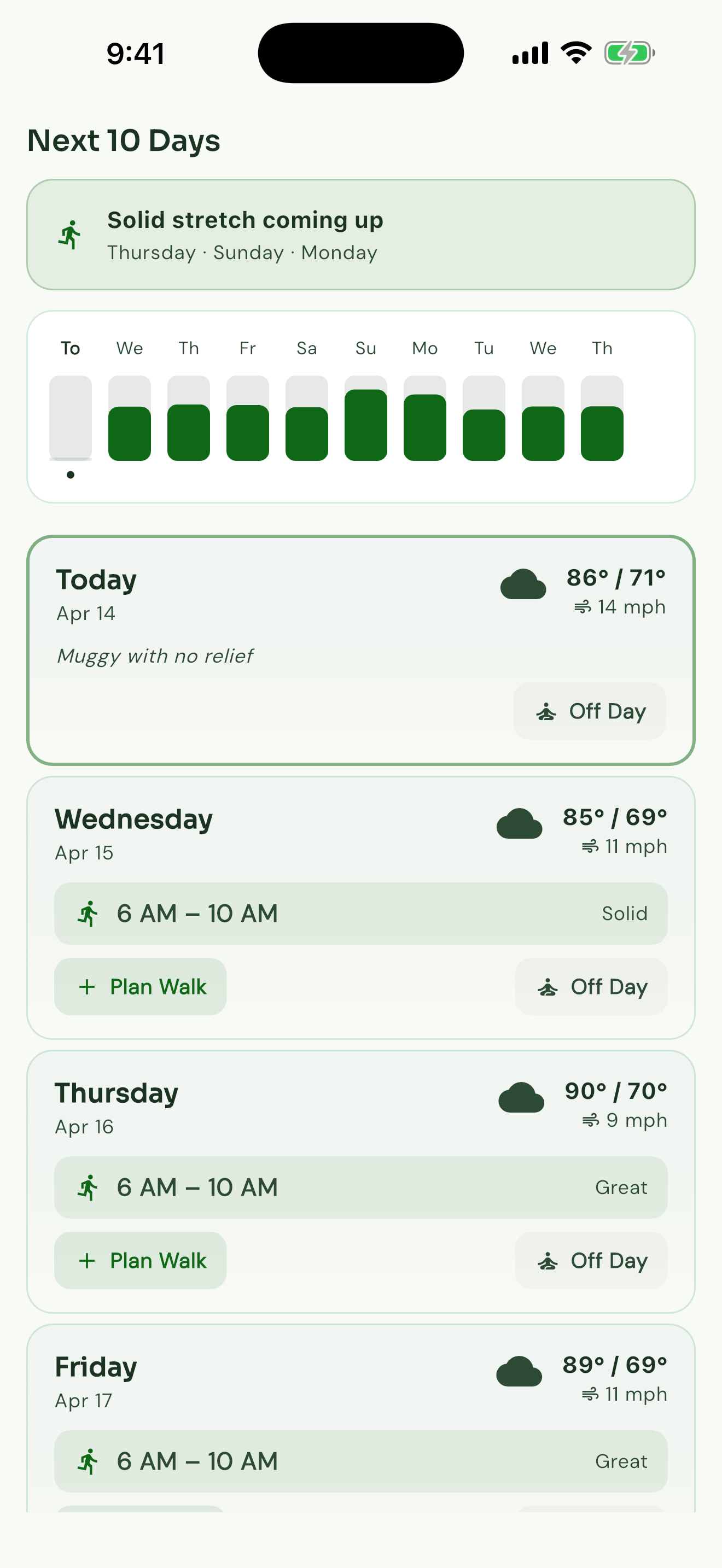
Instead of a number on a thermometer, you get one plain answer about whether today is a good day to walk. A weather app says "75°F." Walk Window says "Head out now — this is your best hour today."
That's the difference between checking the weather and knowing whether to walk.
Frequently Asked Questions
Is it safe to walk in the rain?
Light to moderate rain is fine for walking — it's the lightning that's dangerous. If there's thunder or lightning, stay inside. Otherwise, a rain jacket and appropriate footwear make rainy walks perfectly safe and sometimes quite enjoyable (fewer people, fresh air, cooler temperatures).
Does altitude affect walking temperature?
Yes. Temperature drops roughly 3.5°F per 1,000 feet of elevation gain. A 70°F day at sea level might feel like 56°F at a 4,000-foot mountain trailhead. UV is also stronger at altitude. If you walk at elevation, plan for cooler and sunnier conditions than your city forecast suggests.
What about air quality?
Air quality is an underappreciated factor for walking. High AQI (above 100) means sensitive groups should limit time outside. Above 150, everyone should cut back on outdoor activity. Wildfire smoke, ozone, and particulate matter all affect how safe it is to be out walking.
How do I know the "feels like" temperature?
Most weather apps display a "feels like" temperature that accounts for wind chill (in cold) or heat index (in heat). Use this number, not the actual temperature, when deciding whether to walk. Walk Window reads feels-like temperature as one of the main things that shapes when to head out.