Dog Walking in Hot Weather: Complete Safety Guide
Every summer, veterinary ERs see a surge in heat-related emergencies from dogs who were walked in conditions their bodies couldn't handle. The owners almost always say the same thing: "It didn't feel that hot to me."
That's the core problem. What feels warm to you can be dangerous for your dog. Dogs cool themselves primarily through panting, which is far less efficient than human sweating. They overheat faster, show symptoms later, and deteriorate quickly once heat stress begins.
This guide covers everything you need to walk your dog safely in hot weather — from breed-specific risks to emergency protocols.
Why Dogs Overheat Faster Than Humans
Humans have 2-4 million sweat glands distributed across the entire body. When we get hot, we sweat, the moisture evaporates, and we cool down. It's efficient.
Dogs have sweat glands only on their paw pads — not nearly enough to cool their bodies. Their primary cooling mechanism is panting: pulling air across the moist surfaces of their tongue and respiratory tract. This works reasonably well in moderate conditions but breaks down when:
- Air temperature exceeds body temperature (~101°F for dogs) — panting pushes hot air across already-hot tissue
- Humidity is high — moisture in the air prevents evaporative cooling from panting
- The dog is exerting — exercise generates heat faster than panting can dissipate it
- Airway anatomy is compromised — brachycephalic breeds have shortened airways that reduce panting efficiency
The result: a dog can go from "fine" to "heat emergency" in 15-20 minutes under the wrong conditions.
Breed-Specific Heat Risks
Brachycephalic Breeds (Highest Risk)
Flat-faced breeds have shortened nasal passages and airways that make panting dramatically less effective. These breeds are at the highest risk of heat-related illness:
- Bulldogs (English and French) — the most heat-sensitive common breed
- Pugs
- **Boston Terriers
- Boxers
- Shih Tzus
- Pekingese
- Cavalier King Charles Spaniels
For brachycephalic breeds: Lower all temperature thresholds by 10-15°F. If a guide says "caution above 80°F air temp," your brachy breed needs caution above 65-70°F. Limit walks to early morning and evening year-round from May through September. Keep walks short.
Walk Window's Dog Walker mode includes a breed size selector with a specific Brachycephalic option that adjusts all thresholds accordingly.
Double-Coated Breeds
Huskies, Malamutes, Samoyeds, German Shepherds, Golden Retrievers, and similar breeds have thick double coats that insulate against cold — and trap heat in summer.
- Do not shave double-coated breeds — the undercoat actually provides some insulation against heat and protects against sunburn. Shaving can cause coat damage and doesn't meaningfully reduce heat risk.
- Do brush regularly — removing loose undercoat improves airflow to the skin
- Limit exercise in heat — these breeds overheat during exertion faster than their coat can vent
Small Breeds
Small dogs walk closer to the ground, where radiant heat from hot pavement is strongest. A dog at 6 inches off the ground experiences significantly more reflected heat than a dog at 24 inches.
Small breeds also have a higher surface-area-to-mass ratio, meaning they absorb environmental heat faster.
Large/Giant Breeds
Large breeds generate more internal heat during exercise. They also take longer to cool down because of their mass. While they're less affected by radiant pavement heat, they need longer recovery periods between bouts of exercise in warm weather.
Senior Dogs and Puppies
Both ends of the age spectrum have reduced ability to thermoregulate. Senior dogs may also have compromised cardiovascular systems that make heat stress more dangerous. Puppies under 6 months should not be exercised in heat.
Signs of Heat Exhaustion and Heat Stroke in Dogs
Know the progression. Early intervention saves lives.
Heat Exhaustion (Reversible With Quick Action)
- Heavy, rapid panting that doesn't slow when the dog rests
- Excessive drooling — thick, ropy saliva
- Bright red tongue and gums
- Lethargy — reluctance to continue walking
- Seeking shade — lying down and refusing to move
What to do: Stop the walk immediately. Move to shade or air conditioning. Offer cool (not ice cold) water. Pour cool water over the dog's belly, groin, and paw pads. Monitor for improvement over 15-20 minutes.
Heat Stroke (Medical Emergency)
- Gums turn pale, gray, or blue
- Vomiting or diarrhea
- Stumbling, disorientation, loss of coordination
- Collapse
- Seizures
- Loss of consciousness
What to do: This is a veterinary emergency. Begin active cooling immediately (cool water — not ice — over the body, especially belly and groin). Go to the nearest emergency vet immediately. Organs begin failing within minutes of heat stroke onset. Even dogs that appear to recover may have internal damage.
Critical: Do not use ice or ice-cold water. Extreme cold causes blood vessels to constrict, trapping heat inside the body. Cool water is more effective.
Safe Walking Temperatures for Dogs
Below 80°F Air Temperature (Most Dogs Safe)
Normal walk duration is fine for most breeds. Pavement temperature is the main concern — check on sunny days above 75°F.
80-85°F Air Temperature (Caution)
- Shorten walks to 20-30 minutes
- Avoid midday sun
- Carry water for your dog
- Watch for early heat stress signs
- Brachycephalic breeds: Limit to 10-15 minutes, early morning/evening only
85-90°F Air Temperature (High Risk)
- Walk early morning or evening only
- Keep walks under 20 minutes
- Stay in shade as much as possible
- Bring water and a collapsible bowl
- Brachycephalic breeds: Brief bathroom breaks only — no exercise
Above 90°F (Dangerous)
- Limit outdoor time to brief bathroom breaks
- Early morning before 7 AM is the safest option
- No prolonged walks for any breed
- Brachycephalic breeds: Do not walk outside. Use indoor bathroom options if possible.
Paw Protection
Hot pavement is a separate risk from overheating. Even if the air temperature is manageable, asphalt in direct sun can burn paw pads. Read our complete pavement temperature guide for thresholds and testing methods.
Quick summary:
- Use the 7-second rule: Place the back of your hand on the pavement for 7 seconds. If it's too hot for your hand, it's too hot for paws.
- Walk on grass whenever possible during warm months
- Consider dog booties for dogs that tolerate them
- Apply paw wax (like Musher's Secret) for a protective barrier
- Walk in the early morning when pavement is coolest
Hydration for Dogs
Dogs need significantly more water when exercising in heat:
- Before the walk: Ensure your dog has had water recently (don't force-hydrate, but make sure water is available)
- During the walk: Offer water every 10-15 minutes. Carry a collapsible bowl or use a squeeze bottle.
- After the walk: Unlimited access to cool water
Signs of dehydration in dogs:
- Dry nose and gums
- Thick, sticky saliva
- Skin tenting (gently pinch the skin on the back of the neck — it should snap back immediately. If it stays tented, the dog is dehydrated)
- Lethargy, sunken eyes
Building a Safe Summer Walking Routine
The safest approach to summer dog walking is to restructure your routine around the heat:
- Walk before 7 AM — temperatures are lowest, pavement is cool, UV is low
- Short evening walks after sunset — air has cooled, but test pavement first (it holds heat)
- Skip the midday walk — if your dog needs a bathroom break, keep it brief and on grass
- Shorten the loop — your usual winter walk may need to become a much shorter one in summer
- Choose shaded routes — tree cover makes a dramatic difference in both air and pavement temperature
- Monitor, don't assume — check your dog's condition throughout the walk, not just when you get home
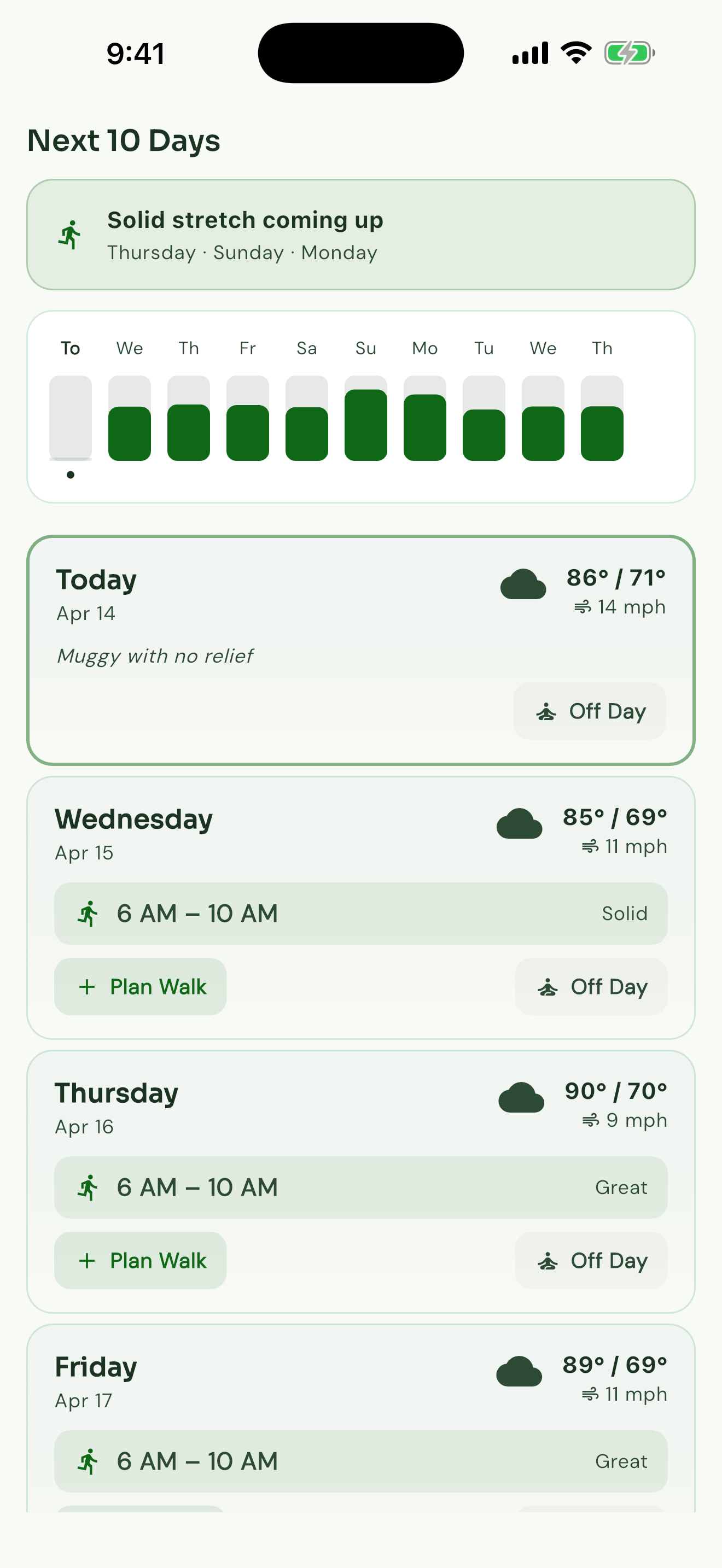
How Walk Window Helps Dog Walkers
Walk Window's Dog Walker mode was built specifically for these challenges. When you tell us you're walking with a dog during onboarding:
- Pavement temperature is shown for every hour, taking air temperature, sun angle, cloud cover, and surface conditions into account
- Safety badges appear on the hourly timeline — green (safe), yellow (caution), red (danger) — so you can see at a glance which hours are safe for paws
- Breed size selection (Small, Medium, Large, Brachycephalic) shifts all thresholds to match your dog's heat sensitivity
- Pavement alerts notify you when conditions enter the caution zone during your typical walking times
- The window we recommend keeps both you and your dog in mind — you won't be pointed to an hour that's fine for you but dangerous for your dog
The app takes the guesswork out of "is it safe?" and gives you a clear yes, caution, or no for every hour of the day.
Frequently Asked Questions
My dog loves being outside in the heat. Does that mean they're fine?
No. Dogs don't always self-regulate well in heat. Many dogs will happily run and play well past the point where they're in danger. It's your job to set limits, not your dog's.
Can I just take my dog swimming instead of walking?
Swimming is excellent exercise and great for cooling. But watch for water quality (blue-green algae is toxic), know your dog's swimming ability, and remember that even in water, dogs can overheat if exercising intensely.
Are cooling vests worth it?
Evaporative cooling vests can reduce a dog's surface temperature by 5-10°F. They're most effective in dry heat (where evaporation works well) and less effective in humid conditions. They help but aren't a substitute for walking at the right hour.
How quickly can a dog get heat stroke?
In extreme conditions (above 90°F with high humidity), a dog can progress from normal to heat stroke in 15-30 minutes of exercise. Brachycephalic breeds can deteriorate even faster. Never assume you'll have time to notice — by the time symptoms are obvious, the situation may already be critical.
Your dog trusts you to make the right call. Check the conditions, time your walks appropriately, and when in doubt, wait for a cooler window.